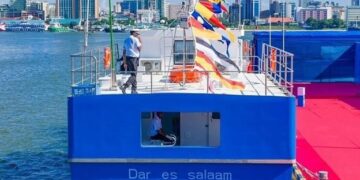










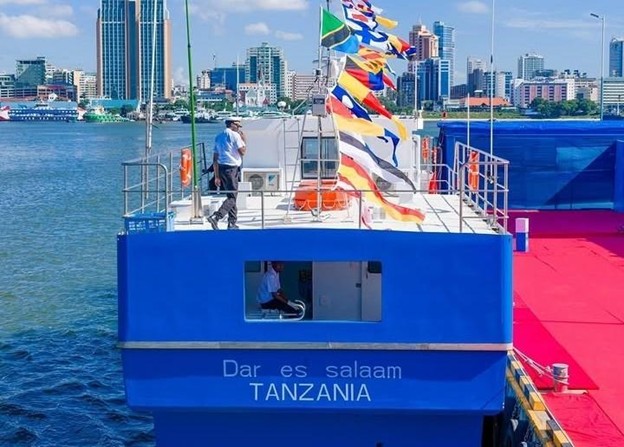
President of the United Republic of Tanzania, H.E. Dr. Samia Suluhu Hassan, has launched the first deep-sea fishing vessel that will enable the country to fish within the Exclusive Economic Zone (EEZ), an area that was previously unreachable due to the absence of such a vessel.


The launch ceremony took place on April 25, 2026 at the waterfront of the Tanzania Fisheries Corporation (TAFICO) headquarters in Kigamboni, Dar es Salaam, where President Samia stated that the move is aimed at expanding employment opportunities, increasing government revenue, and improving nutrition.
The vessel, funded by the Government of Japan and valued at approximately $2.9 million, is equipped with advanced fish preservation technology.
“I commend the Government of Japan for partnering with us in building this vessel, and through them, in collaboration with UNDP, we will also receive two high-speed patrol boats to oversee surveillance of deep-sea fishing,” President Samia added.
President Samia framed the vessel launch as the foundation of a long-term national strategy, capturing more value from its marine resources.
Minister for Livestock and Fisheries, H.E. Ambassador Dr. Bashiru Ally Kakurwa stated that this vessel is part of four additional vessels the Government plans to purchase to further strengthen deep-sea fishing operations.
The broader framework for this revival is the Tanzania Marine Fisheries and Aquaculture Development Project, a five-year initiative running from 2025 to 2030. The project’s objectives are structured around the entire fisheries value chain: developing landing sites, constructing fish processing plants, building markets, and supporting research and training. It represents the most substantial coordinated investment in Tanzania’s fisheries sector in the country’s post-independence history.
Investment Opportunities in Tanzania’s Fisheries Sector
Tanzania’s fisheries sector presents a wide range of investment opportunities across both inland and marine fisheries. Key areas include fishing vessel and gear manufacturing, fish processing facilities, aquaculture, aquarium fish business, fishing support services, and aquatic tourism. The inland fisheries account for 85% of national fish production, yet remain significantly underdeveloped, leaving substantial room for private sector entry.
On the processing side, Tanzania currently exports fish primarily in fresh or frozen form, meaning the value-added segment such as fish canning, hot and cold smoking, and processed products remains largely untapped. In marine fisheries, the government is actively reviving TAFICO and developing fishing harbour infrastructure to support offshore operations, while strengthening the foundation for private sector participation.