












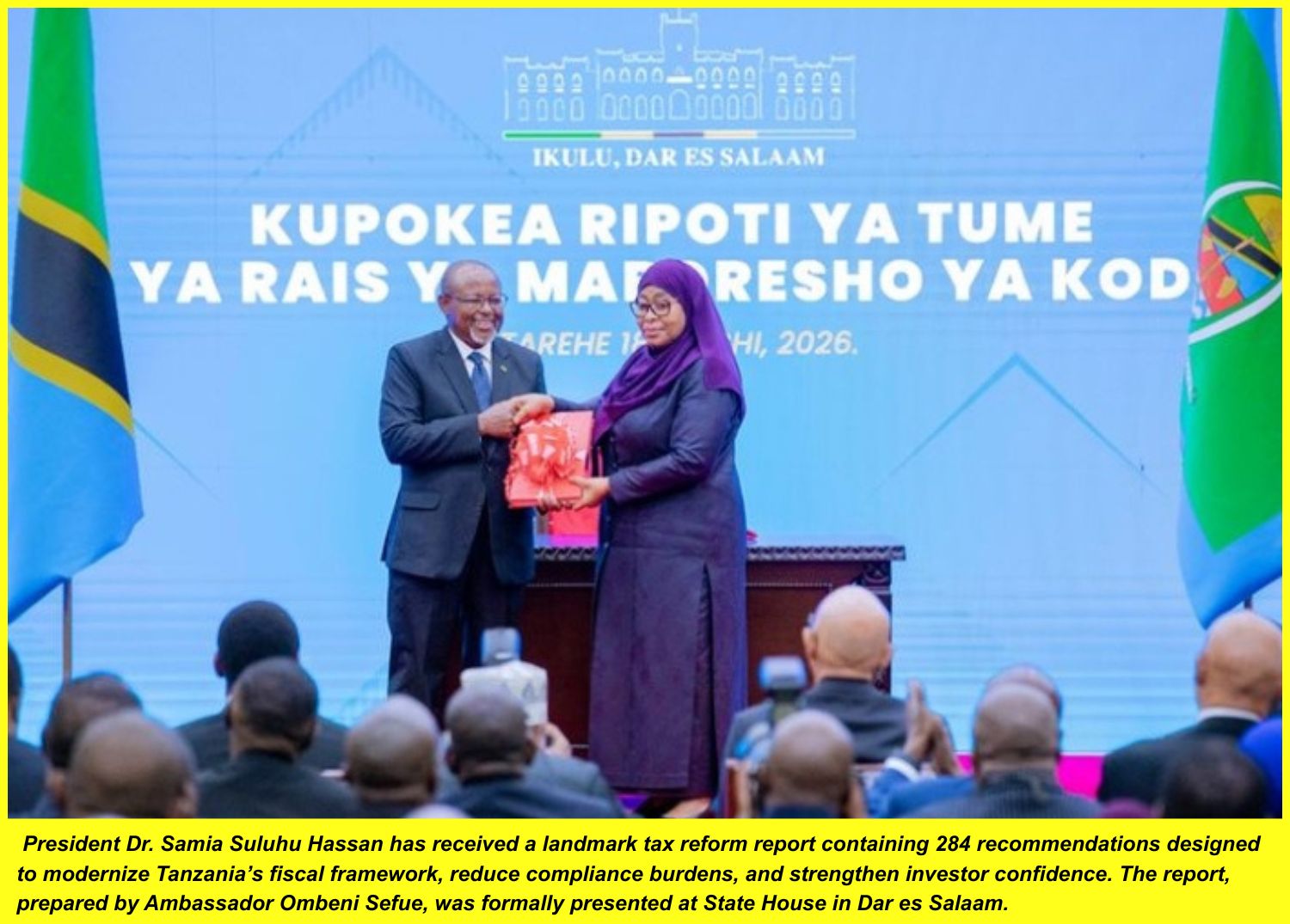
DAR ES SALAAM. President Dr. Samia Suluhu Hassan has received a landmark tax reform report containing 284 recommendations designed to modernize Tanzania’s fiscal framework, reduce compliance burdens, and strengthen investor confidence. The report, prepared by a presidential commission chaired by Ambassador Ombeni Sefue, was formally presented at State House in Dar es Salaam.


Tackling Long‑Standing Challenges
For years, businesses have cited Tanzania’s tax system as a barrier to growth, pointing to multiple overlapping levies, high compliance costs, and unpredictable policy changes. Analysts argue these inefficiencies have discouraged private sector expansion and contributed to a large informal economy.
The commission stressed that addressing these issues is essential to unlocking Tanzania’s economic potential and improving competitiveness within East Africa.
Key Measures to Simplify and Modernise Taxation
At the core of the reform agenda is a transition toward a simplified, transparent, and investor-friendly tax system.
The 284 proposals include:
- Introduction of a National Tax Policy to guide future fiscal decisions and eliminate ad hoc changes
- Streamlining tax laws to reduce duplication and improve clarity
- Full digitalisation of tax administration, enabling online registration, filing, and payment
- Establishment of an independent Tax Ombudsman to resolve disputes efficiently
- Reduction of nuisance levies (“tozo”) imposed by multiple regulatory bodies
Importantly, the reforms also recommend transforming the Tanzania Revenue Authority (TRA) into a more service-oriented institution.
“The objective is to move from an enforcement-heavy system to one that encourages voluntary compliance and supports taxpayers,” the commission noted in its findings.
Broadening the Tax Base
Rather than raising tax rates, the reforms focus on expanding the tax base. Measures include simplifying compliance for SMEs and offering temporary tax relief for start-ups, which is expected to distribute the burden more equitably while increasing overall revenue.
Aligning with Long‑Term Ambitions
The overhaul is closely tied to Tanzania’s ambition to become a $1 trillion economy by 2050. President Samia underscored the importance of predictability:
“A predictable and fair tax system is essential for building investor confidence and supporting sustainable economic growth.”
Expected Impact
If implemented effectively, the reforms could deliver measurable benefits within three years, including:
- Higher government revenue and improved tax‑to‑GDP ratio
- Increased formalisation of SMEs
- Stronger trust between taxpayers and authorities
- Lower compliance costs and reduced uncertainty for investors
Investor Outlook
Taken together, the proposals signal a strategic shift toward a more growth‑oriented fiscal framework. For investors, the implications are clear: improved planning visibility, reduced regulatory risk, and a more competitive environment compared to regional peers.