












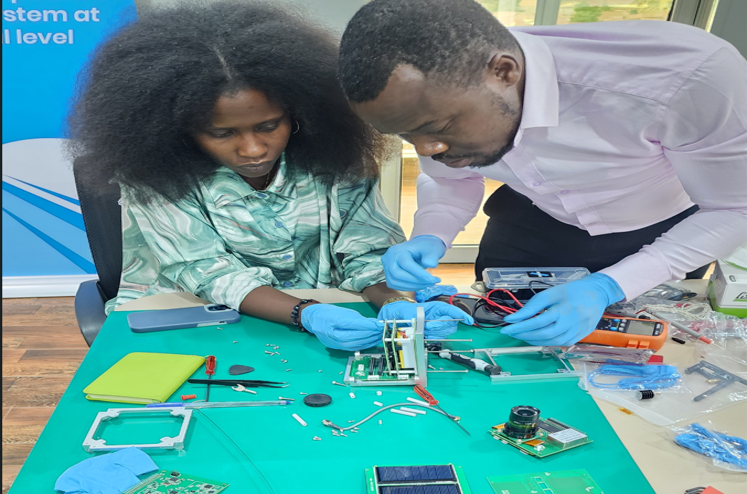
This may be the industry story that seems the least likely on paper out of all the ones that have been making headlines in Tanzania this year, including mining train agreements, avocado processing facilities, and fintech festivals: Tanzania is constructing a satellite. Not going to, not researching the concept. Actually, getting the gear.


The Hardware Is Ordered
Under the Kibo CUBE program, which is run by the UN Office for Outer Space Affairs in collaboration with organizations that assist developing nations in gaining access to space technology in the first place, Tanzania has finished all procurement procedures for the equipment needed to develop its first small satellite. It sounds like a small milestone, like procurement paperwork instead of a rocket launch, but it is also the kind of unglamorous administrative action that really decides whether an ambitious concept becomes a real satellite or remains a press release. The revelation was initially reported by the industry newsletter Space in Africa, which frames it as part of a larger continental trend: an increasing number of African governments increasingly view satellite technology as critical infrastructure for national development rather than a vanity project for wealthier nations.
The Policy Scaffolding Behind It
The satellite itself is part of a much bigger institutional movement. Minister Angellah Kairuki, who is well-known from this year’s fintech festival coverage, has confirmed that the ministry is currently developing a 2026 National Space Policy and a 2026 Space Act, laws intended to create a functional legal environment for satellite development and the practical application of space technology across the economy. The government has also unveiled a Five-Year Strategic Plan for Space Programs covering 2025 to 2030.
The plan’s stated pillars, which include governance frameworks and institutional arrangements, a greater Tanzanian presence in international space efforts, human capital and research development, public awareness campaigns, space infrastructure itself, and most importantly active promotion of space technology applications across every economic and social sector, not just as a scientific curiosity, read like a checklist for building a space sector roughly from scratch. In order to advance the human capital component, the ministry has collaborated with the State University of Zanzibar, the University of Dar es Salaam, the University of Dodoma, and Mbeya University of Science and Technology to purchase ICT equipment to modernize labs in advance of specialized training programs in digital technology.
Zanzibar’s President Makes the Pitch to Teenagers
The movement is not limited to ministry policy texts or the mainland. President Hussein Ali Mwinyi urged young people to take astronomy and space science more seriously during a meeting with leaders of the Zanzibar Astronomy Space Society on September 21 at the State House in Zanzibar. Stronger interest in these subjects, he claimed, would help Zanzibari youngsters stay up with technological progress, develop true research skills, and apply contemporary techniques to the development issues the islands actually face. His reasoning was pragmatic rather than idealistic. In order to increase access to the field, he also advocated for greater cooperation between the government, academic institutions, and science stakeholders. He suggested that the head of state view membership in astronomy clubs as a means of developing the workforce rather than only for stargazing.
Where Space Tech Actually Touches the Ground
The clearest explanation for why any of this material appears in Tanzanian farm fields rather than in orbit. As Tanzania expands its own use of space technology to modernize agriculture, policymakers and innovators are actively studying Finland’s model, which combines satellite imagery, artificial intelligence, and mobile technology to monitor farmers’ fields, verify agricultural activity, and even process subsidy payments. Given how important farming is to the nation, the stakes are difficult to overestimate. According to the Agriculture Minister’s own 2026–2027 budget numbers, agriculture expanded 4% in 2025, provided 24.6% of GDP, and accounted for 64.6% of all jobs. Satellite-based agricultural planning, weather forecasting, and improved crop monitoring are not only abstract technological tricks. Nearly two-thirds of Tanzania’s workforce may be directly impacted by this infrastructure. The €35 million Digital4Tanzania e-Governance Support Program of the European Union, which runs through 2026, is assisting in the development of the digital government and connectivity infrastructure that this type of application would eventually rely on.
The Younger Generation Is Already Building
The nation’s youth innovation pipeline may be the most compelling proof that this is not merely top-down policy theater. This year, 162 proposals were shortlisted by Young Scientists Tanzania, which is currently in its sixth year of collaboration with Exim Bank Tanzania. The top 45 projects will be presented at the Young Scientists Tanzania National Science and Technology Exhibition on September 17 at the University of Dar es Salaam. The initiative produces considerably more than school science fair submissions, according to its organizers. A number of former participants have pursued jobs in science and technology, while others have developed their initial undergraduate projects into successful enterprises. If satellite development is to become a sustainable Tanzanian capacity rather than a one-time procurement milestone, a national space program will eventually need to rely on this kind of grassroots talent stream.
At Innovation Week 2026, which took place from August 31 to September 4 under the theme “From Aspirations to Transformation: Innovating Tanzania’s Path to Inclusive Prosperity,” officials, researchers, entrepreneurs, and young innovators openly debated what it will truly take to create a trillion-dollar, knowledge-based economy. One keynote speaker pointed out that conferences and policy documents alone cannot clearly address this question.
The Bigger Picture
At Innovation Week 2026, which took place from August 31 to September 4 under the theme “From Aspirations to Transformation: Innovating Tanzania’s Path to Inclusive Prosperity,” officials, researchers, entrepreneurs, and young innovators openly debated what it will truly take to create a trillion-dollar, knowledge-based economy. One keynote speaker pointed out that conferences and policy documents alone cannot clearly address this question.