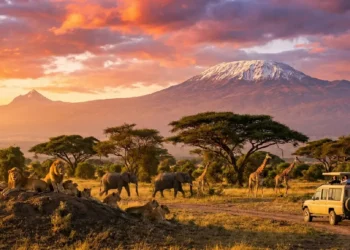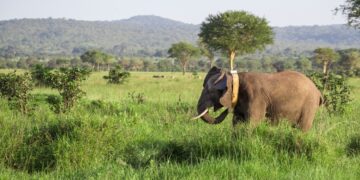











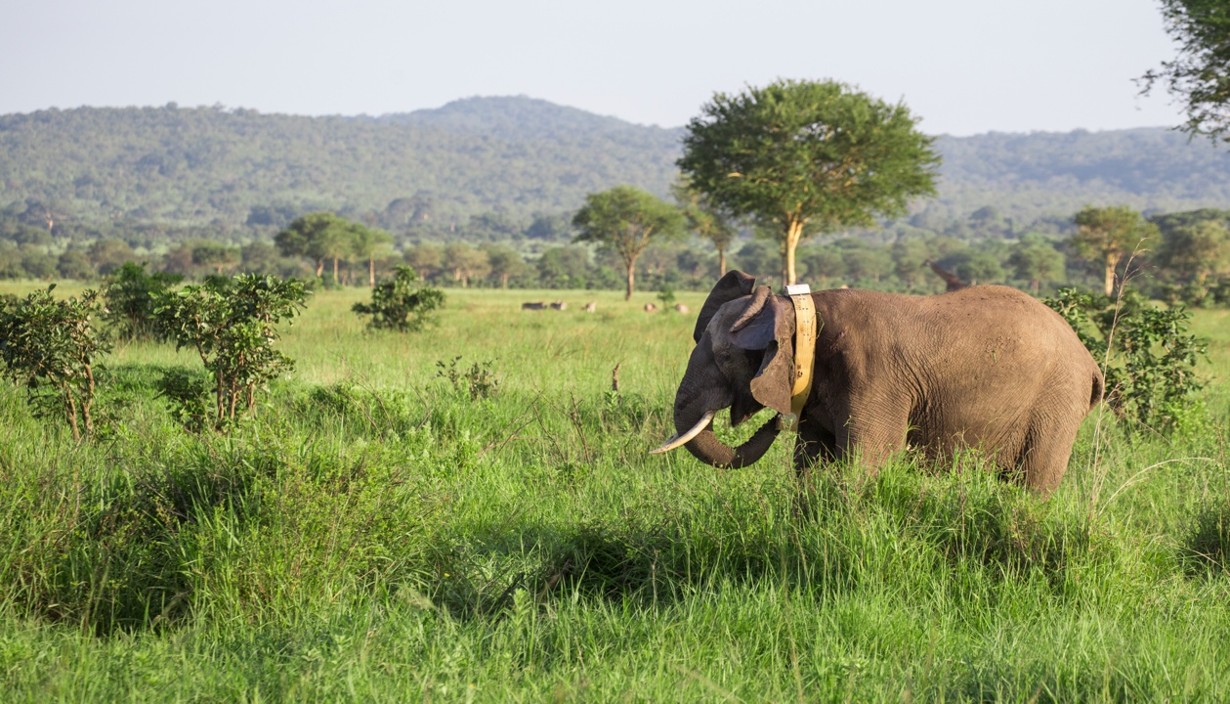
A mother elephant is leading her herd toward a waterhole she has known since she was a calf somewhere in the Meatu District’s acacia scrub. Unbeknownst to her, she is also a data point at this precise time. Her location is updated by satellite every few hours, and she appears as a tiny blinking icon on a laptop screen at a distant office. A GPS collar, around the weight of an automobile battery, is slung around her neck. It was designed to withstand the crushing power of the only animal on the planet that might easily destroy it.


This is Tanzania’s latest attempt to solve an age-old dilemma: how can you coexist with an animal that can crush a field of maize in a single night and knows precisely where the good water is, even if it means going through someone is village?
Ten Collars, Eight Herds, One Very Old Conflict
The Tanzania Wildlife Research Institute (TAWIRI) reports that 10 elephants from eight herds that wander the Meatu terrain have now been fitted with satellite collars. These collars are purposefully placed on the matriarchs and lead bulls who set the group’s path. You can successfully track the herd by following the leader. Elephants are matriarchal society, and where the eldest, most seasoned female goes, the others usually follow. This is a subtly beautiful bit of field biology.
Supported by the Friedkin Conservation Fund at an approximate cost of $88,000, the project uses Mwiba Holdings, which manages conservation operations in the region in conjunction with Tanzania Game Trackers Safaris, to route its data. The objective is to provide farmers and rangers with a real-time early warning system, not to behaviorally confine the elephants. Instead of reacting after a field, a fence, or worse, a life has already been lost, rangers can move ahead of a collared matriarch when her coordinates begin to drift toward agriculture or a settlement, pushing herds back toward the bush before conflict arises.
The program’s outcomes are already being acknowledged by local leadership. Since the collaring started, there have been fewer elephant-related incidents, according to the chairperson of Meatu Council. The same conservation partnership has also extended into the community, providing school meals for more than a thousand students at two primary schools and constructing a state-of-the-art kitchen at one of them. It appears that feeding the kids and making the elephants happy are now on the same ledger in Meatu.
The Bigger Picture: A Population Finding Its Feet Again
Although the Meatu collars are a local tale, they are part of a wider national one. The results of TAWIRI’s most thorough wildlife census to date, the first in ten years and the first to concurrently encompass all of the nation’s biological systems, were made public in June 2026. With an estimated 130,000 elephants, Tanzania is currently the third-largest elephant population in Africa, behind only Botswana and Zimbabwe.
That number has significant weight. In the 2000s and early 2010s, industrial-scale poaching severely damaged Tanzania’s elephant population, especially in the Selous and Ruaha habitats, where the ivory trade destroyed herds. The recovery shown in this year’s census, along with record numbers of lions (roughly 17,200, also a continental high) and buffalo (roughly 328,000, the highest in Africa), is the result of more than ten years of habitat protection, anti-poaching enforcement, and, increasingly, technology like the collars that are now humming silently around Meatu’s matriarchs.
However, recuperation has its own set of challenges. A program like this is being actively monitored as a potential model for other conflict-prone districts since more elephants traveling over a landscape that also has more farms, roads, and people than it had twenty years ago means more contact sites between the two.
Old Instinct, New Infrastructure
The story’s central picture, an animal whose migratory memory has been passed down from mother to daughter for ages, has a subtle lyrical quality. She is traversing the same seasonal patterns while wearing a piece of orbital equipment around her neck. The satellite is not necessary for the elephant. She is already aware of her destination. Humans are increasingly in need of assistance in catching up.
Funding, upkeep of the collars themselves (batteries fail, straps fade, animals grow), and the more difficult and time-consuming task of land-use planning that maintains corridors accessible in the first place will determine whether this strategy expands beyond Meatu. However, an ancient conflict between farmers and elephants is currently being handled one satellite ping at a time in one part of Simiyu Region.